
12 Secrets Of An Employee Engagement Survey That Gets Results
Virtually every organization conducts an employee engagement survey. And with recent data from Leadership IQ showing that only 41% of employees meet the criteria for being highly engaged, employee surveys are clearly very necessary.
Yet notwithstanding the ubiquity of the survey approach for gathering employee feedback, only 22% of organizations get good outcomes from their employee engagement surveys (i.e., survey scores were low but they've improved dramatically, or the scores were high and remained high).
How can you ensure that your employee engagement survey delivers winning results? Follow these 12 lessons gleaned from research with more than one million employees and thousands of employee engagement surveys.
Here’s a summary of what you’ll find out on this page (click any link to skip to that section):
- Only Ask Survey Questions You Can Fix (Secret #1)
- Don't Make This An Employee Satisfaction Survey (Secret #2)
- Don't Focus On Your Lowest Scores (Secret #3)
- Don't Use A 5-Point Likert Scale (Secret #4)
- Candidly Share The Detailed Survey Results (Secret #5)
- Don't Treat Your Employee Engagement Survey As A Research Project (Secret #6)
- Don't Make Employee Engagement A Human Resource Problem (Secret #7)
- Understand The True Cause Of A Disengaged Employee (Secret #8)
- Assess The Employee Engagement Of Your High Performers (Secret #9)
- The Issues Facing Remote Employees (Secret #10)
- Test The Effectiveness Of Your Corporate Strategy (Secret #11)
- Identify Your Risks Of Employee Burnout (Secret #12)
- QUIZ: How Good Is Your Employee Engagement Survey?
Only Ask Survey Questions You Can Fix (Secret #1)
Here's a key rule for your next employee engagement survey: Never ask a survey question you don't know how to fix (or can't fix). When you ask an employee survey question, you're essentially promising that you're going to take action based on the feedback you get. If you break that promise, your employees will get angry very quickly.
Here are some very common employee engagement survey questions that break this rule:
- I have great friends at work
- I like my boss
- My boss values me as a person
- I trust my boss
Those seem like decent questions until you try to figure out, "How would I correct a low score on one of these survey questions?" Put another way, what actionable insights did you get from those questions?
Let's say you score low on a question like, "I trust my boss." Do you know precisely why employees don't trust their bosses and how to correct that issue? Maybe you could teach leaders how to be more honest. Or do a better job of sharing really positive news. Or be more candid in talking about the company's challenges. Or listen more empathically when employees share their problems. Or solicit suggestions for improvement.
All of those options could be actionable insights, but you have no idea which one of those actions your employees wanted to see improved when they said that they have trust issues with their boss. Because you don't really know the precise issues driving those lower employee engagement levels, you're probably going to guess wrong.
Instead of an unfixable employee survey question, try asking a question like: "When I share my work problems with my direct leader, they respond constructively." (Source: Leadership IQ's employee engagement survey).
That's a question for employee surveys that can be quickly fixed. When employees share problems, you can train leaders how to listen without defensiveness, accept the issue with gratitude, and respond empathically and constructively.

You can test your current employee engagement survey by looking hard at every one of your current survey questions and asking, "Do I know exactly what actions will fix this issue?" It's not good enough to be able to guess what might work; you have to know with complete certainty what you will do.
If you don't have a definitive answer, that employee engagement survey question could cause you real trouble (and should be eliminated).
Don't Make This An Employee Satisfaction Survey (Secret #2)
Employee engagement means that an employee will give 100% effort and will shout from the rooftops that this is a great employer (aka they're willing to recommend the company as a great employer).
Engaged employees meet both of those criteria, and when they do, their emotional states will be characterized by a deep sense of pride, fulfillment and even excitement. Their employee experience will be great and their employee sentiment will be overwhelmingly positive.
Employee satisfaction, however, is a much weaker psychological concept (and not nearly as robust as employee engagement). Employee satisfaction is often measured with questions like "Overall, I am satisfied with this company" or "I am satisfied with my job."

The word satisfied typically means something like "content." Contentment isn't bad, of course, but it invokes memories of relaxing on a beach. That's nice, but is contentment what you're really trying to get from your employees?
Do you recruit star employees so they can bask in the sun feeling content, or so that they charge into the office bursting with energy to give 100% effort?
If you want to know if employees will shout from the rooftops what a great employer you are, and whether they're inspired to give 100% effort, you have to generate survey responses that give you those answers.
For example, take the survey question, "Working here inspires me to give my best effort." (Source: Leadership IQ's employee engagement survey).
That's a question that goes far beyond employee satisfaction and contentment, and gets to the much deeper issue of being inspired to give your best effort.
That's the bottom line with an employee engagement survey; do you want a content employee relaxing on a beach or do you want an engaged employee inspired to give their best effort?
Don't Focus On Your Lowest Scores (Secret #3)
Imagine an organization conducts an employee engagement survey and asks workers to assess leadership, corporate culture, and the employee experience.
But then imagine that executives decide to also ask employees about the corporate colors, food services, and the quality of carpeting in the office.
Finally, imagine that after the survey results are tabulated that employees loathe the company color scheme, food in the cafeteria, and the carpet in the office.
Those are the lowest scores on the employee engagement survey, but is that what's really driving low employee engagement or predicting your next engaged employee? If you had to choose between developing managers to do a better job of employee recognition or improve the office carpet, which one of those will help you retain your star employees? (Hint: You probably don't have a disengaged employee on your team because of a poor carpeting choice).
You may not have received your lowest scores on issues like performance management, management candor, or workplace culture, but those might be the problems most in need of an action plan.
The problem with focusing primarily on the lowest scores in your employee engagement survey results is that those low scores often don't drive an employee's willingness to give 100% effort or recommend your company as a great employer. To discover which issues actually do impact and drive employee engagement, you need a multivariate statistical analysis like multiple regression analysis.
Multiple regression is a statistical analysis for predicting the value of one dependent variable based on multiple independent variables. In other words, it's a tool to reveal which survey questions are the biggest drivers of employee engagement for your unique group of employees.
Let's look at real-life multiple regression analysis for an employee survey.

This analysis says that over half (53%) of an employee's willingness to recommend this company is driven by whether their direct leader encourages and recognizes suggestions for improvement. On an employee engagement survey with dozens of questions, this regression analysis discovered that one issue literally predicted more than half of this company's employees engagement.
If the company fixes this one issue, they're virtually guaranteed to see a big increase in employee engagement scores.
By the way, CEOs love the regression analysis because it eliminates guessing and wasted time, and gives an immediately actionable improvement plan that's unique to your company culture and employee experience.
Have your employee survey scores been flat year over year? Multiple regression precisely forecasts which survey questions will give you an immediate statistical jump in employee engagement levels.
And for any human resource leader, you want to be able to demonstrate fast and practical value to the rest of your executive team. That's how a human resource professional can significantly increase their reputation.
Don't Use A 5-Point Likert Scale (Secret #4)
If your engagement level hasn't changed much, even after multiple surveys, it could be because you're using the wrong survey scale. The most common employee engagement survey scale is the 5-point scale; think of a Likert scale ranging from Strongly Agree to Strongly Disagree. Those scales are perfectly fine for social science research, but the typical employee engagement survey is very different because your data is highly skewed.
The 5-point scale was designed for situations where the feedback is likely to be normally distributed, where the probability is roughly that as many respondents will score 1's as they do 5's.
If you ask 100,000 random people to give feedback on the statement, "Buffalo wings taste delicious," you'll get a wide range of responses. Some people love Buffalo wings but only during football games, some think they're the perfect food, others dislike the spiciness and greasiness, and still others have never eaten properly prepared wings.
But when you survey a group of people who are getting paid by a company, 5-point survey results are far more biased and skewed (i.e., you'll receive many more 5's than 1's). If you measure employee engagement at ACME Inc. and ask them to rate the statement, "ACME is a fantastic place to work," you won't get many terrible responses (i.e., 1's and 2's).
That's because if an employee truly thought ACME was a horrendous place to work, they probably would have quit already.
But because they're still coming to work, they're basically giving the feedback that while they might be frustrated, they're not so angry that they're quitting. Of course, there are some people who hate ACME and just haven't found a new job yet, but there are not enough people with a universally negative employee perception to undo the bias in the data.
The solution to this is using a 7-point scale, especially one that ranges from Never to Always. You'll still have some data skewing, of course, but because you're now using a broader scale, you're going to see far more subtle improvements in your engagement level.
Candidly Share The Detailed Survey Results (Secret #5)
A critical step that needs to happen immediately after an engagement survey is sharing the survey results with the employees who actually took the survey. Unfortunately, this communication doesn't happen nearly as frequently as it should (especially from the manager level).
Recent data shows that only 29% of companies say that all of their managers share the survey results with their employees.

Do we really expect that our workforce will blindly accept that the company is going to make serious changes based on the results of the employee engagement survey?
Of course not, so it falls on managers (the leaders closest to the frontline employees) to ensure that the strengths, opportunities and feedback discovered in the employee survey are communicated with honesty, candor and transparency.
Also note that you can't just share the company-wide results and stop there. An organization can have high overall employee engagement but still have many disengaged employees in specific areas (departments, divisions, etc.).
And if leaders aren't willing to openly share the less stellar results, it's as though we haven't really shared the results.
Don't Treat Your Employee Engagement Survey As A Research Project (Secret #6)
Too many companies think that the purpose of an employee engagement survey is to measure employee engagement and just gather feedback.
It's not; the purpose of conducting a survey is to actually improve employee engagement.
Engagement surveys are too time-consuming on the part of the employees answering the questions for this to be an exercise conducted 'out of curiosity.'
Currently only 42% of human resource executives say that their company is 100% willing to take action on every single question on their survey.
While that might not seem awful, this data tells us that 58% of companies (a majority) are not taking real action based on the data from their employee engagement survey.

When we conduct an employee engagement survey, we're implying a promise to every team member that we're going to actually do something with their answers.
If a company asks employees to spend time and energy to answer survey questions about their engagement level, and we dismiss those responses, we can expect to see some justifiably untrusting employees.
Don't Make Employee Engagement A Human Resource Problem (Secret #7)
Your employee engagement strategy won't work if you're not prepared to give your managers the specific tools needed to correct the issues identified.
Leadership IQ's research has found it takes a minimum of a few solid days of leadership training (or a few weeks of distributed training) to give managers enough skills to do the job effectively.
If your survey discovers that employees think performance management is subpar, or that career development doesn't work, you need to train managers how to deliver robust feedback and coach employees through a career development process.
If your survey reveals that employees don't fully understand their manager's goals, you need to train leaders how to clearly set and communicate goals.
If your survey discovers that employees don't think their manager holds low performers accountable, you need to teach managers how to better improve employee performance.
If employees don't feel that their work is valued at this company, then managers need specific training in employee recognition.
Of course, human resources will be involved in all of those activities, but ultimately it will fall to managers to implement those actions.
Understand The True Cause Of A Disengaged Employee (Secret #8)
According to research from Leadership IQ, 26% of employees are Motivated But Unhappy. These are people who dislike their company but are still motivated to give 100% effort at work. And while outmoded statistics and overly simplistic survey responses might consider them a disengaged employee, Motivated But Unhappy employees are far from being actively disengaged.
It's quite likely, for example, that some employees are willing to give 100% at work even though they dislike their current workplace or their employee morale is low.

Everyone knows people who dislike their company but still show up and work incredibly hard and deliver great productivity. It's wrong to call these people disengaged employees, because Motivated But Unhappy employees are essentially just as motivated to give 100% as engaged employees. Where they differ is the extent to which they're likely to recommend their company as a great place to work.
It's clearly a bad practice to characterize everyone who's not a classically engaged employee as 'disengaged employees,' or 'unengaged employees' or 'actively disengaged.'
Motivated But Unhappy employees are nearly as motivated as engaged employees, but they see numerous problems with their current workplace and culture.
This will have a significant impact on their turnover rates, and could eventually impact their productivity, quality, and more. That's why our employee engagement targets the precise causes of disengagement and dissatisfaction so that both leaders and employees can quickly boost morale.
Employee voice only matters if we're listening to the issues that really drive their performance, and motivation is one of the biggest issues we need to assess.
Assess The Employee Engagement Of Your High Performers (Secret #9)
A famous Leadership IQ study discovered that in 42% of organizations, high performers were less engaged than low performers.
Put another way, your best employees were more likely to be disengaged than employees with the worst performance. And think about how that impacts the employee retention of your best employees.
A survey technique pioneered by Leadership IQ matching your employee performance appraisal scores to your employee engagement scores to discover whether your best employees are at risk of burnout, turnover, and decreasing morale.
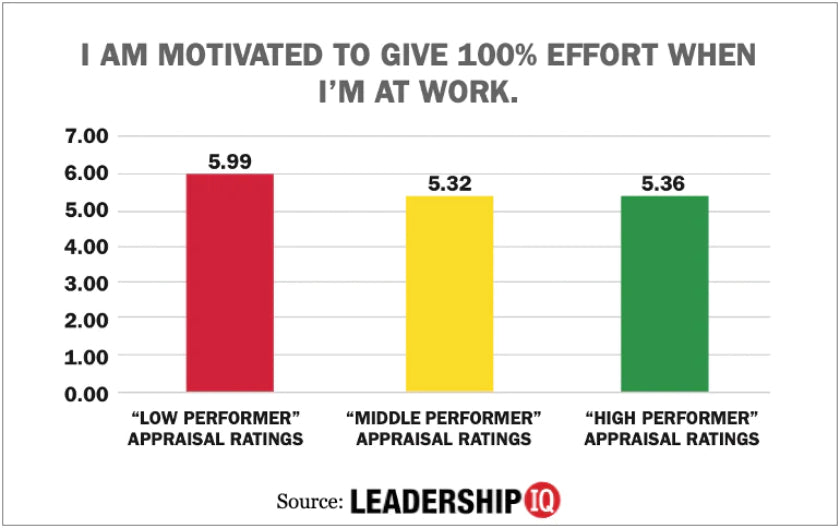
Some of your employees come in to work every day trying to change the world, while others are there for just a paycheck and nothing more.
You want to make sure that the people who are giving 100% of their discretionary effort to the job are not being unduly burdened by picking up the slack for the people who don't care as much as they do.
You don't want the employees bringing you the least value to be more engaged than the folks who reliably deliver good and great performance.
There are ample reasons why this puts organizations at risk. And one of them is the fact that high performers, who thrive on being highly engaged, will have drastically higher employee turnover if they aren't engaged.
The Issues Facing Remote Employees (Secret #10)
Has working from home eroded employees' mental health, engagement, work-life balance, and more? Or has it actually made life better?
The truth is that there are a great many employees who have not only survived, but thrived, while working from home.
And certain personality traits accurately predict whether someone is going to love or hate the experience of working from home (aka working remotely).
In Leadership IQ's employee engagement survey, for example, we pinpoint exactly which employees are thriving and which ones are struggling. We also identify which personality characteristics are most important to protecting the employee morale of your remote employees.
For example, in a recent Leadership IQ study, we discovered that 52% of people with high resilience found that their work-life balance was much better working from home, and only 23% found that it was much better or a little better working in an office.
By contrast, only 33% of people with low resilience found that their work-life balance was much better working from home, and 33% found that it was much better or a little better working in an office.

You'll need to discover which of your employees are going to thrive working remotely, and which ones need extra support and coaching.
Just asking for employee opinion isn't enough, we have to know how to immediately help them thrive.
Test The Effectiveness Of Your Corporate Strategy (Secret #11)
Imagine that you're the CEO or senior leadership of a company, and you discover that 71% of your managers and employees don't have strategic alignment with your vision.
Do you think there's any chance that you're going to hit your targets this year? Or next? Of course not.
In fact, it doesn't matter how good or innovative your company's vision is; if leaders and team members at every level of the company aren't fully aligned with that vision, it has almost no chance of success.
And disturbingly, rampant misalignment is precisely what research from Leadership IQ has discovered.
One of the findings is that only 29% of employees say that their leader's vision for the future always seems to be aligned with the organization's.
One of the critical roles of an employee survey is to ensure that employees and leaders at all levels are fully aligned with the current corporate strategy happens to be. And that clearly is not happening.
That's why we strongly encourage you to ask employee survey questions designed specifically to test whether every employee and manager is fully aligned with your corporate strategy.
And where they're not aligned, the employee survey pinpoints the precise areas in need of more support and coaching.
When you're conducting an employee feedback survey, why wouldn't you take the extra step to actually assess the effectiveness of your corporate strategy?
Identify Your Risks Of Employee Burnout (Secret #12)
Most of us are feeling more burned out than usual (we all can feel that gnawing pessimism and fatigue creeping into the backs of our minds).
And not only is that burnout dramatically hurting our mental health, but research has also shown that burnout damages productivity and increases mistakes, which no business can afford right now.
Among the biggest drivers of burnout are low optimism, resilience, self-forgiveness, assertiveness, and striving.
Fortunately, those are all mental health factors that you can measure in an employee engagement survey. (For example, Leadership IQ’s employee engagement survey specifically measures those issues).

Every one of your employees needs to know exactly how to improve their psychological characteristics to protect themselves against employee burnout. And with advanced analytics, you'll discover which departments, job roles, and divisions have the highest risk of burnout, and exactly what actions you should take to stop that burnout immediately.
This will have a tremendous positive impact on your company culture and employee retention.
USE MORE ACTIONABLE OPEN-ENDED SURVEY QUESTIONS (Secret #13)
Many organizations use one or two open-ended questions on their employee engagement surveys.
However, it may come as a surprise that more than three-quarters of these companies report that they are unable to effectively utilize these open-ended questions to boost employee engagement.
Open-ended survey questions are often phrased in a way such as "Please share any ideas that you think would enhance employee satisfaction at XYZ." While this type of question may seem harmless, unless employees are accustomed to providing detailed and practical suggestions, their responses may contain a lot of irrelevant information.
One possible reason for choosing this type of question is that it may avoid confronting the negative and unjustifiable issues that employees experience in their workplaces.
An alternative would be a more pointed open-ended question such as "What is one concern you have at work that you believe your manager has the power to resolve immediately?"
This is a question that Leadership IQ frequently uses in surveys and research, including in the study "Burnout at Work." The answers to this question are far more specific and actionable.
QUIZ: How Good Is Your Employee Engagement Survey?