
Data Shows That Every Recruiter Needs To Start By Defining The Right Attitudes
It’s pretty hard to recruit a high performer if you don’t know what attitudes define being a high performer. That’s like being told to go buy a great computer, with no clarification about what ‘great’ means. PC or Mac? Desktop or laptop? 13 inch or 17inch? The list is endless.
If you’re a recruiter, it’s pretty untenable to be tasked with recruiting high performers without further clarification about what constitutes ‘high performance.’ And yet, that’s exactly what most companies are doing to their recruiters.
At Leadership IQ, we recently surveyed 656 human resources executives and asked them to what extent their organization had clearly and scientifically defined the attitudes that distinguish the highest performers from everyone else. Here’s what they said:

If you’re a recruiter, those are pretty scary numbers. How can you possibly recruit high performing employees when there’s a good chance that the company has NOT thoroughly defined the attitudes that distinguish high performers from low performers?
A Little Background On Defining The Right Attitudes
Before I give more data from our study, let me take a step back and offer a few thoughts on defining attitudes. You’ve probably already seen the research that led to my book Hiring for Attitude (see more data here) so you know that when new hires fail on the job, it’s generally for attitudinal reasons, not for a lack of skill.
The need for attitudinal hiring is easy enough to demonstrate, but doing it is another matter. Not only is attitude tougher to assess in candidates than skills, but a lot of organizations (and recruiters) aren’t even all that clear about the specific attitudes they should be looking for.
The “right” attitude is as unique as the organization to which it belongs. For example, Southwest Airlines and the Ritz-Carlton are both great companies, but the attitudes driving their respective success are as different as night and day. And it goes without saying that someone who is competitive and individualistic may be the perfect fit for a solo-hunter commission-driven sales force or Wall Street financial firm. But put that same personality to work in a collaborative, team-loving culture, and that individualistic superstar is doomed to fail.
It’s not enough for a company or recruiter to say ‘attitude is important’—we need to define the attitudes that define success (and failure) for our company’s specific employees.
So here’s my question for every recruiter: To what extent has your organization clearly and scientifically defined the attitudes that distinguish the highest performers from everyone else (i.e. low and middle performers)?
We know what those 656 HR executives had to say…
But let’s now take a little deeper dive into these numbers. One of the other questions we asked on this survey was “What percentage of new hires were your first choice candidate?”
This is a good metric of the effectiveness of your recruiting pitch, because if you can close the deal with your first choice candidates, you’re going to win the war for talent in your industry. And if you’re always stuck with second or third choice candidates, then either you’re targeting the wrong people or your recruiting pitch isn’t good enough (including your brand, compensation, benefits, culture etc.).
Poor Recruiting Companies
Let’s first look at companies with a poor recruiting pitch—companies that said they got their first-choice candidate anywhere from 0%-40% of the time.

The first thing that jumps out is that companies that struggle to hire their first-choice candidate almost never clearly define the attitudes that distinguish their high performers (a paltry 1%). Maybe that’s why they struggle?
Now, about half of these poor recruiting companies did ‘somewhat’ define their high performer attitudes, but that’s clearly not good enough. And a whopping 45% had not defined their high performer attitudes at all.
Good Recruiting Companies
By contrast, companies that regularly get their first-choice candidates (90-100% of the time) look quite different.
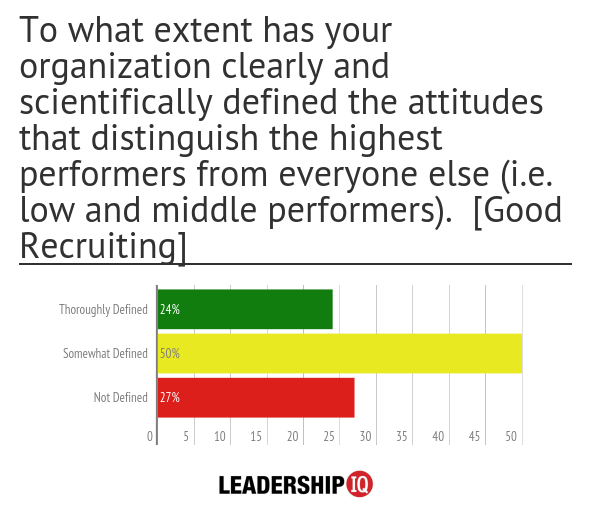
24% of these good recruiting companies have clearly defined their high performer attitudes (compared with 1% for poor recruiting companies). And 27% of good recruiting companies have NOT defined their high performer attitudes (compared with 45% of poor recruiting companies).
The Lesson For Every Recruiter: Defining Attitudes Matters
As you can see from these charts, defining high performer attitudes is really quite important. If this data is any indication, it’s going to be pretty hard to hire your first choice candidates if your organization hasn’t clearly defined its high performer attitudes.
If you’re the recruiter, trying to attract high performers, it behooves you to get as much clarification as you can about what attitudes are ‘high performer.’ You may have to push for it. You may have to do a good bit of internal consulting. But ultimately, your ability to recruit and hire your first-choice candidates depends on knowing those attitudes.