This event is now past. You can purchase this content with our e-learning library. You can contact Nicole Jordan, VP of Business Development, via email at nicole@leadershipiq.com

We’ve all heard that if you make employees happy, they’ll give you great performance. But a new book reveals the failure of that idea. Trying to make employees happy does not automatically deliver great performance.

In fact, a groundbreaking new book shows that for all the billions of dollars companies have spent trying to satisfy and engage employees, 72% of employees admit they’re still not giving their best effort at work.

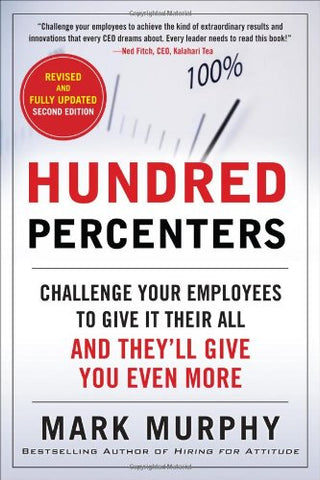
In “Hundred Percenters: Challenge Your Employees to Give it Their All, and They’ll Give You Even More” (McGraw-Hill November, 2009), Mark Murphy, the founder and CEO of Leadership IQ, divulges new research from more than 500,000 employees and leaders about why the “happy employee” philosophy has failed and how leaders can inspire employees to passionately give 100% every day.

Mark Murphy will host two free webcasts (they’re both the same) on Tuesday, December 15 at 12:00 PM EST and Wednesday, December 16 at 2:00 PM EST. In each 60-minute webcast, Mark will reveal exciting new research on the best leadership style for inspiring employees to become hundred percenters.

Choose one of these time slots to reserve your seat:

Click here to register for Tuesday, December 15 at 12:00 PM EST

Click here to register for Wednesday, December 16 at 2:00 PM EST

Here are just a few of the big ideas in “Hundred Percenters” that Mark will discuss:

  • More than 70% of employees would rather work for a leader who challenged them with difficult goals and required them to learn new skills.
  • If leaders assign really difficult goals, employees perform better and have more self-confidence.
  • SMART Goals can be dumb, and often discourage employees from pushing themselves and developing new skills.
  • Many leaders unknowingly discourage employees from becoming hundred percenters through insufficient recognition and tolerating slackers.
  • Hundred percenters want lots of constructive feedback, but you should never deliver it with a Compliment Sandwich.
  • If you’re going to assess your employees with a survey, never ask if they’re satisfied (and never use a five-point scale).
  • You cannot build an organization of hundred percenters if you tolerate Talented Terrors (people with 100% skills but 0% attitude).
  • “Hundred Percenters” debunks many recent management fads. The truth is that employees cannot be bribed into giving 100%. Nor can they be coddled into greatness. Instead, this book describes a new leadership model that pushes employees to discover and maximize their unrealized potential, while leaving them beaming with hard-won pride and fulfillment.

    Choose one of these time slots to reserve your seat:

    Click here to register for Tuesday, December 15 at 12:00 PM EST

    Click here to register for Wednesday, December 16 at 2:00 PM EST


    You can buy the book here:

    hundred percenters book hundred percenters book hundred percenters book

    About the Author:
    Mark MurphyMark Murphy, Chairman & CEO of Leadership IQ
    Mark Murphy is one of the country’s leading management experts. Mark has lectured at Harvard Business School, Yale University, and more. His clients include Microsoft, IBM, GE, MasterCard, Merck, AstraZeneca, MD Anderson Cancer Center, Johns Hopkins, and hundreds more.

    Mark leads one of the largest leadership studies ever, and his groundbreaking work has appeared in Fortune, Forbes, Business Week, Investor’s Business Daily, The Washington Post, The Los Angeles Times, and many more. He has also appeared on ABC’s 20/20, CBS News, Fox Business News and NPR.

    Mark has authored 3 bestselling books, including Generation Y and the New Rules of Management, The Deadly Sins of Employee Retention, and Leading on the Edge of Chaos.

    Mark Murphy is a 3-time nominee for Modern Healthcare’s “Most Powerful People in Healthcare” Award. And Mark won the Healthcare Financial Management Association’s Helen Yerger Award for Best Research.