How to Develop Leaders in Your Organization: A Practical Framework

Why Developing Leaders Is Every Organization's Most Important Job
Only 20.4% of employees believe their leader can distinguish between high and low performers. That's not just a leadership problem — it's an organizational crisis. Leadership IQ research found that employees with excellent leaders show 35% higher engagement. But when you survey HR directors, 67% admit their managers regularly avoid giving critical feedback, and only 35% would trust their managers to handle difficult employees without HR supervision.
Organizations with effective leadership exhibit improved employee engagement and retention — one Gallup study revealed that 70% of variance in team engagement is solely determined by the team's manager. Leadership development increases organizational capacity and boosts employee retention by up to 20 times greater. Developing leaders isn't optional — it's a strategic lever that directly impacts every metric your organization cares about.
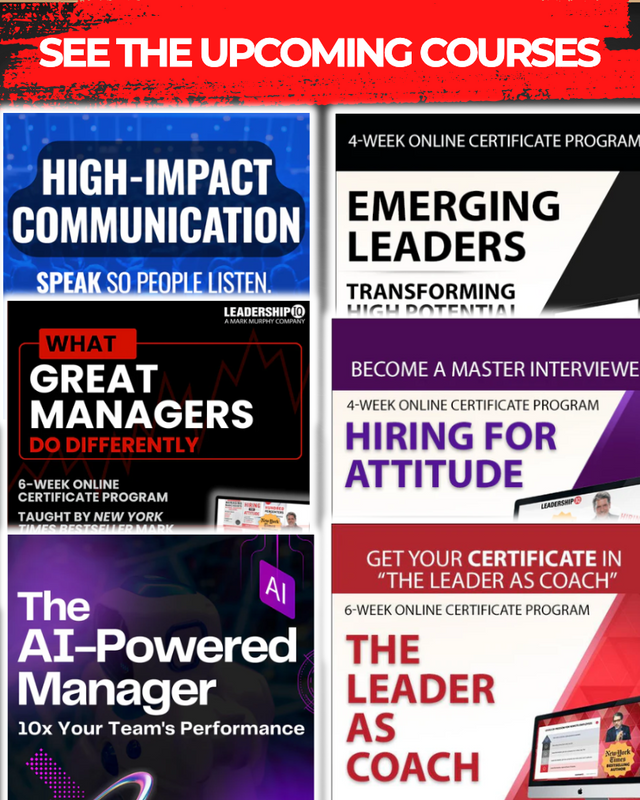
This guide covers the practical roadmap for building future leaders: core competencies, identification of high potential employees, development opportunities, coaching, measurement, and action plans. If you're ready to start, explore Leadership IQ's training programs. For personalized development, consider executive coaching. Or bring these frameworks to your organization through a leadership keynote.
Start by understanding your own leadership style — it shapes how you develop others:
Developing Leaders: The Core Principle
Great leaders are teachers first. The first thing exceptional leaders teach their people is the difference between good work and great work — yet Leadership IQ research of 30,000 employees found that only 29% always know whether their performance meets expectations. You can't build leaders who don't understand performance standards themselves.
The most effective approach uses Word Pictures — detailed behavioral descriptions that distinguish between "Needs Work," "Good Work," and "Great Work." When you ask five employees to define great teamwork, you'll get five different answers. That's confusion that undermines your entire development strategy. Leaders developing leaders starts with this clarity.
Effective leadership development programs must be linked to the organization's long term vision and current market challenges. Aligning leadership competencies with the company's core values cultivates leaders who model behaviors that strengthen the culture. Leadership development must be part of the organization's long-term strategy, embedding it into talent management practices to create a pipeline of future ready leaders.

Core Competencies for Future Leaders
The core competencies required for effective leadership include emotional intelligence, adaptability, strategic thinking, communication skills, and decision making abilities. Soft skills such as emotional intelligence, effective communication, and conflict resolution are equally important as hard skills. Leadership development drives performance by nurturing skills like communication, delegation, and strategic thinking.
Communication Skills
Map essential communication skills by role: frontline leaders need feedback delivery and coaching conversations; mid-level managers need stakeholder alignment and upward communication; senior leaders need executive presence and crisis communication. Design active-listening exercises: practice paraphrasing before responding, noticing emotional undertones, and asking clarifying questions. Assign presentation practice and require peer feedback after presentations. High engagement and motivation in teams is fostered by leaders who communicate clearly and recognize contributions.
Emotional Intelligence
Emotional intelligence (EQ) is projected to be among the top skills required in the business world. Nearly half of employees believe social and emotional intelligence are key leadership traits, and teams led by managers with high EQ exhibit lower rates of absenteeism and increased profitability. The demand for EQ is expected to increase by 26% by 2030.
Measure EQ using validated assessments. Coach self awareness exercises: pause three times daily to name the emotion you're feeling. Embed empathy simulations into training — practice reading emotional situations before they escalate. Self awareness involves understanding one's own strengths and weaknesses and the "ripple effect" of one's actions on others.
Decision Making
Teach structured decision making frameworks: define the decision, list options, evaluate criteria, decide within a timeframe, communicate rationale. Run scenario-based decision exercises using real organizational challenges. Review post-decision outcomes for learning — the debrief is where decision making capability actually develops. Effective leaders balance data, experience, and judgment to make timely informed decisions.
Identify High Potential Employees and Emerging Leaders
Identifying high potential employees early involves assessing qualities such as initiative, emotional intelligence, and leadership potential — not just job performance. Tools like 360-degree feedback, regular one-on-ones, and feedback loops help organizations spot high-potential employees. Use performance-potential matrices to rank candidates. Interview managers for high-potential nominations.
Look for employees who naturally teach others the difference between good and great work — individual contributors who emerge as informal mentors. Watch for those who take ownership during difficult situations rather than deflecting responsibility. The best predictor of future leadership success isn't individual performance metrics — it's whether people around them perform better. Potential leaders elevate their environment.
Assess Emerging Leaders
Administer competency assessments for emerging leaders. Observe candidates in live stretch assignments — how they handle ambiguity, complex situations, and interpersonal conflict reveals more than any assessment score. Document learning agility and adaptability evidence. Effective senior leaders implement a disciplined process for regular assessments of high performers to evaluate readiness for promotion and development opportunities.
How to Build Leaders from Within
Building leadership capacity requires addressing the skills gaps that actually matter. Leadership IQ surveyed 3,018 leaders across 18 critical leadership skills: only 19% are adept at reducing burnout, 26% at developing middle performers, 28% at managing hybrid teams, 43% at delivering constructive feedback, and 40% at overcoming resistance to change.
The 70-20-10 Learning Model states that 70% of leadership development should come from on-the-job experiences. Connect development activities to real workplace scenarios — not generic workshops. Address the energy allocation problem: 61% of managers spend more time fixing worst performers than developing best people, creating conditions where 68% of high performers face burnout risk.
Trained leaders manage conflict constructively, creating a safer, more productive environment. Effective leadership directly impacts team performance by enhancing engagement and improving decision making. Continuous feedback loops replace annual reviews with ongoing feedback and 360-degree assessments to help leaders adjust behaviors in real-time.
Create Development Opportunities and Stretch Assignments
Creating opportunities for stretch assignments allows emerging leaders to step out of their comfort zones, fostering growth through real-world challenges. Design cross-functional projects for exposure to different parts of the business. Rotate roles to expand leadership breadth. Assign high-visibility initiatives with clear outcomes. Provide project sponsorship from senior leaders — when executives invest time in emerging leaders', it signals organizational commitment to development.
Give potential leaders opportunities to train others, lead project teams, and participate in problem solving initiatives. The goal isn't to accelerate their promotion timeline but to build the foundation skills they'll need when leadership opportunities arise. Organizations that embed leadership development into their culture foster a continuous learning environment essential for adapting to change and driving long term success.
Coaching Culture and Constructive Feedback
Train managers in coaching fundamentals — moving from telling to asking, from directing to developing. Schedule regular one-on-one development meetings focused on growth, not just status. Teach constructive feedback techniques using the FIRE framework (Facts, Interpretation, Reaction, End result). Require goal-focused feedback after major tasks.
A culture of continuous learning is supported by open communication and constructive feedback, which promotes a transparent environment where employees feel valued. When 67% of managers avoid critical feedback, your leadership development must specifically address this gap — because leaders who can't give feedback can't develop others.
Deliver Constructive Feedback
Offer timely feedback within 48 hours of events — delayed feedback loses impact. Focus feedback on observable behaviors only — not personality or character. Pair feedback with a specific development task: "Here's what I observed. Here's what I'd like to see. Here's how we'll practice it." This approach turns every feedback conversation into a development opportunity.
Build Effective Leadership for Complex Challenges
Simulate complex challenges in learning labs — present scenarios with incomplete information, competing priorities, and time pressure. Teach systems thinking to broaden perspective — leaders need to see how decisions in one area ripple across the organization. Create team-based problem solving workshops where emerging leaders practice navigating complex problems collaboratively.
Decision Making for Complex Challenges
Introduce probabilistic thinking exercises — not every decision has a clear right answer. Practice rapid decisions under time pressure. Debrief complex decisions to capture lessons: "What information did we have? What did we assume? What would we do differently?" This reflection cycle builds the decision making muscle that effective leaders need for new challenges.
Developing Potential Leaders: Identifying Them Early
The biggest mistake is waiting too long. By the time someone is promoted to management, you've missed opportunities to shape their leadership mindset. Early identification isn't about picking favorites — it's about recognizing behavioral patterns that predict leadership success. Look for those who naturally teach, take ownership, ask improvement questions, and help struggling team members succeed.
Early development should expand natural tendencies. Most importantly, measure their impact on others — potential leaders make the people around them better. Effective leadership is crucial for maintaining alignment, ensuring strategies are executed with precision and that employees feel motivated to contribute their best efforts.
Common Mistakes Organizations Make
Treating leadership development as an event rather than an ongoing process. Developing leaders in isolation from actual work challenges. The promotion trap — assuming high individual contributors will automatically become effective leaders. The feedback avoidance problem. And underestimating the time investment required — building leadership capacity is a multi-year commitment requiring consistent support, resources, and organizational patience. Paying attention to these pitfalls prevents the most common failure modes in developing leaders.
Measure Progress and Create an Action Plan
Define leadership KPIs and success metrics: engagement scores within leaders' spans of control, feedback conversation frequency, development milestone completion, talent pipeline coverage ratios, and promotion readiness rates. Track development milestones monthly. Report progress to senior stakeholders quarterly.
Create Leadership Action Plan
Set SMART development goals for each leader: "By end of quarter, deliver structured feedback using the FIRE framework at least twice weekly" is actionable. "Improve communication" is not. Assign mentors to ensure accountability. Schedule quarterly review checkpoints. The action plan connects leadership goals to organizational goals — because developing leaders only matters if it drives meaningful change in business results.
How Leadership IQ Can Support Developing Leaders
Pilot Leadership IQ diagnostics with one cohort: leadership style assessments, 360-degree feedback, and skill gap analysis provide the baseline data your development strategy needs. Integrate Leadership IQ content into leadership programs — research-backed frameworks for feedback delivery, performance differentiation, coaching conversations, and change management. Leverage Leadership IQ coaching for high potential employees who need personalized development beyond group training.
Research-driven leadership training addresses the specific skill gaps that impact organizational performance. The goal isn't to create identical leaders but to ensure every manager has the core capabilities needed to succeed — creating consistency in how your organization develops talent, manages performance, and drives results across all levels. Continuous development of leadership capabilities is what separates organizations that thrive from those that merely survive.
Build Your Leadership Pipeline
Ready to build your leadership pipeline? Leadership IQ's research-driven training programs accelerate leader development by giving managers the specific tools and skills they need for today's leadership challenges — from developing middle performers to leading change to reducing burnout.
Explore Leadership IQ's leadership training programs.
You can also explore executive coaching for personalized leadership development or bring these frameworks to your organization through a leadership keynote.