
Autocratic Leadership: New Data Reveals Who Likes It
Autocratic leadership (also referred to as authoritarian leadership) is a leadership style in which the leader retains absolute authority over decisions, tells employees exactly how tasks and projects should be performed, and maintains strict control over processes and outcomes. The autocratic leader doesn't solicit much input from team members, nor do employees have much freedom to choose how to perform their work. Among all the different leadership styles, autocratic leadership is the most directive, the most structured, and the least participative.
This autocratic leadership style is particularly effective in high-pressure environments such as military operations, emergency response teams, and manufacturing, where quick decision-making and clear direction are essential. In compliance-heavy industries and crisis management situations, autocratic leadership provides the necessary structure and decisiveness to ensure safety and efficiency. But it's far from universally appropriate—and the data shows that most employees don't want it.
This article presents original research from Leadership IQ on who actually responds well to autocratic leadership, examines the key characteristics, profiles real-world autocratic leaders, and provides a balanced analysis of the pros and cons. Whether you're evaluating your own leadership approach or designing leadership development programs, understanding when this style works—and when it damages—is essential.
Overview of Autocratic Leadership Style
Autocratic leadership is defined by centralized decision-making power, a clear chain of command, strict rules, and little or no input from subordinates. The leader makes decisions unilaterally, establishes deadlines and performance standards, and expects team members to execute exactly as directed. It's a management style that prioritizes efficiency, compliance, and control over collaboration, innovation, or employee autonomy.
Common use cases include military operations, emergency response, manufacturing and production environments, healthcare settings where patient safety requires strict protocols, and any situation where the cost of slow or incorrect decisions is extremely high. This leadership style works best in highly structured environments where tasks are well-defined and the stakes are high, allowing leaders to maintain control and ensure operations run smoothly without delays. It's also beneficial when working with inexperienced teams or new employees who require clear guidance and direction to perform their tasks effectively.
Characteristics of Autocratic Leadership
The key characteristics of autocratic leadership distinguish it from every other leadership approach:
Centralized decision making: Only one person makes the calls. The autocratic leader retains decision making power and absolute authority over significant choices. Group discussions may occur, but the leader has the final say—and often doesn't seek input at all.
Strict control and monitoring: Autocratic leaders typically maintain strict control over how work is performed, closely monitoring employee performance and intervening when standards aren't met. There's a strong focus on compliance and adherence to established procedures.
Limited subordinate input: Team members are expected to execute, not to contribute ideas or challenge the leader's direction. This is fundamentally different from democratic leadership or participative leadership, where group members actively participate in the decision making process.
Clear chain of command: The hierarchy is explicit. Everyone knows who reports to whom, who has authority, and what the leader's status is within the organization. A clear chain of command speeds execution because there's no ambiguity about who decides what.

Autocratic Leadership: New Data Reveals Who Likes It
Leadership IQ surveyed 14,033 people about the style of their ideal leader, and further assessed respondents on several dozen personality characteristics, to determine whether certain types of people actually desired—and responded well to—autocratic leadership.
To assess how much people liked autocratic leadership, we asked them to rate two questions that represent an autocratic style:
- My ideal leader always retains the final decision making authority within the department.
- My ideal leader tells employees exactly how they would like tasks/projects to be performed.
As you can see in the first chart, a small minority of people really want a leader who always retains the final decision making authority within the department. This "command and control" decision-making process is generally less desired today than democratic leadership, participative leadership, or transformational leadership.
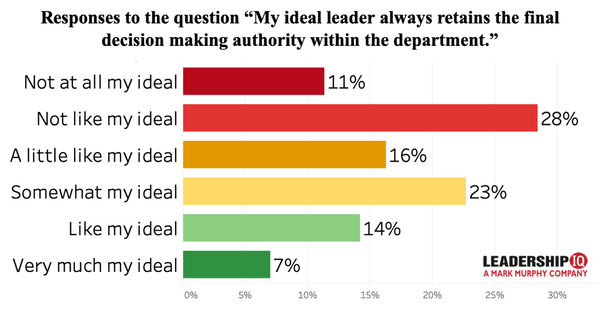
The data tells a clear story: about 21% of employees do see benefits in autocratic leadership, particularly a leader taking a strong role in making decisions. That's not a majority, but it's not trivial either. Roughly one in five people actually prefer a directive leadership approach when it comes to who holds decision making power.
As you see in the next chart, fewer people desire a leader who tells employees exactly how they would like tasks and projects to be performed. Concepts like job autonomy, job crafting, and intrinsic motivation are more desired in today's workplaces than highly directive leadership styles.
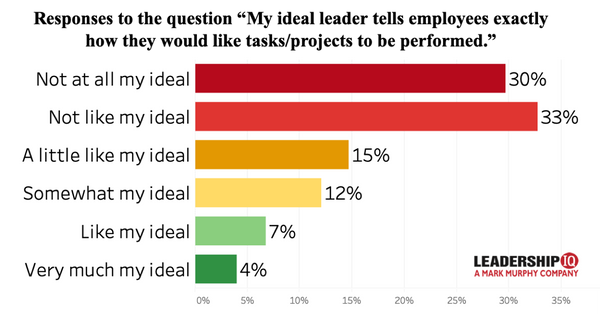
But again, about 11% of people really do want a leader to tell them exactly how to perform their work. These employees aren't lazy or unambitious—they have specific personality characteristics that make autocratic leadership a comfortable and productive fit.
Typically when the cons of autocratic leadership are discussed, the disadvantages take priority. We'll hear examples of autocratic leaders like Attila the Hun, Genghis Khan, and Napoleon Bonaparte, and hear how autocratic leadership ruins employee morale. And when the benefits are discussed, it's typically reduced to "strong leadership is necessary when the building's on fire."
While the dangers of autocratic leadership and authoritarian leadership are very real, it's an oversimplification to say they're universally harmful to the work environment. Because as the data shows, certain personality types actually like autocratic leadership.
Personality Types That Respond to Autocratic Leadership
Out of more than two dozen personality characteristics assessed, we identified seven characteristics that were positively correlated with idealizing autocratic leadership. Understanding these characteristics helps explain how autocratic leadership actually functions in practice—and why writing it off entirely ignores a meaningful segment of the workforce.
People who idealize autocratic leadership believe that people should do what they're told and follow the rules. They also believe that, in general, people should be satisfied with the status quo and not ask for more than what they have. This is consistent with the autocratic leader's tendency to tightly hold authority, whether in a decision-making process, directing tasks, or maintaining the leader's status within the hierarchy.
Followers of autocratic leadership are also more cautious than followers of other leadership styles. They are more likely to believe in the adage, "If it ain't broke, don't break it." They're more likely to adhere to the notion that it's better to be safe than risk being sorry.
Given the autocratic leader's emphasis on formal procedures, strict rules, and setting clear expectations, it's no surprise that their followers tend to favor making decisions by way of careful, detailed analysis.
Finally, while there are people who love the adrenaline rush that comes from frequent and unexpected change, the people that idealize autocratic leadership definitely prefer consistency and routine.
Personality Characteristic #1: Follow the Rules
If someone believes that people should do what they're told and follow the rules, they're more likely to idealize an autocratic leader. In fact, the more someone prioritizes the importance of rules, the more they'll idealize autocratic leadership. The scatterplot below shows the positive relationship between these factors:
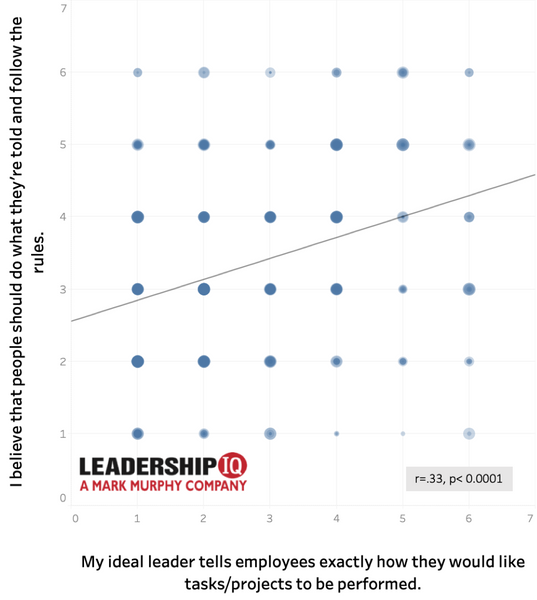
The strong upward-sloping trend line makes it clear: for people who believe that the world is better when people just follow the rules, autocratic leadership is actually fairly desirable. But for rules-breakers and those who enjoy a bit of disorder, autocratic leadership is likely to be incredibly painful. This data point alone helps explain why the same autocratic style that one employee finds structured and reassuring, another finds suffocating.
Personality Characteristic #2: I Like Rules
Similar to the previous characteristic, the more someone likes having rules and detailed processes, the more they're likely to embrace autocratic leadership.
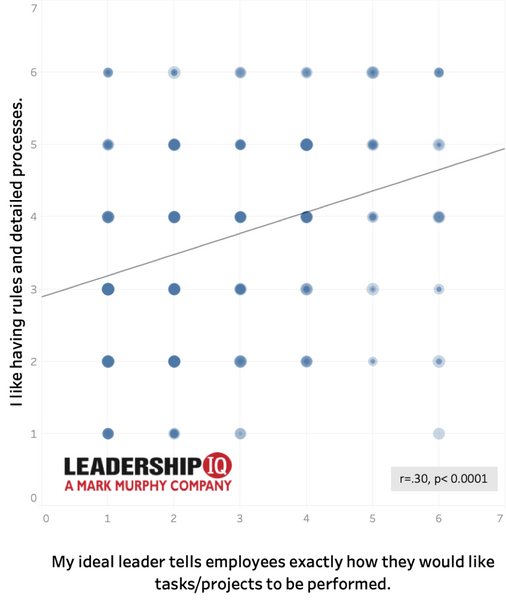
Autocratic leadership does not encourage lots of freedom, messiness, or disorder—it's the opposite of democratic leadership or participative leadership. And while many will chafe in that environment, for those who enjoy the consistency and stability that rules and processes bring, autocratic leadership is actually desirable. The data shows a clear positive correlation between process-orientation and comfort with directive leadership.
Personality Characteristic #3: Consistent Routines Are Good
One area where autocratic leadership (and authoritarian leadership) excels is creating consistency. The autocratic style may not be fun and lighthearted, but in general, "the trains run on time." So it makes sense that someone who enjoys having a consistent routine would be more likely to embrace autocratic leadership.
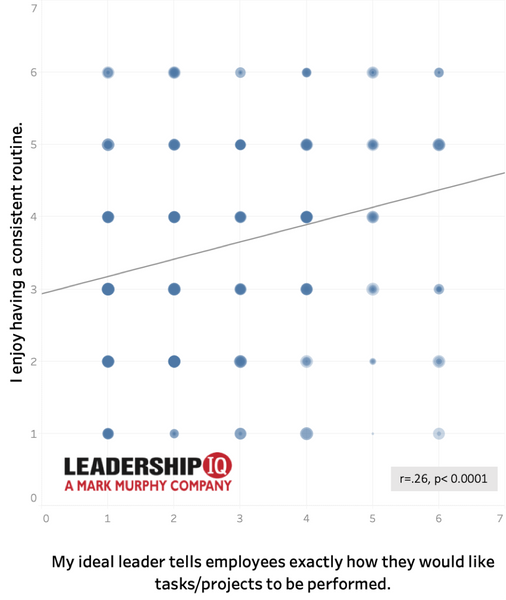
Consistent routines don't automatically mean that group members will love working for an autocratic leader. But the data does show that employee morale will likely be higher in that scenario than for someone who does not prize consistency in their routines. This is an important nuance for leaders evaluating whether the autocratic style fits their team's personality profile.
Personality Characteristic #4: Play It Safe
An autocratic leader is more likely to use "carrots and sticks" (rewards and punishments) than someone who practices transformational leadership, for example. So it's no surprise that people who believe it's better to be safe than risk being sorry respond more favorably to autocratic leadership.
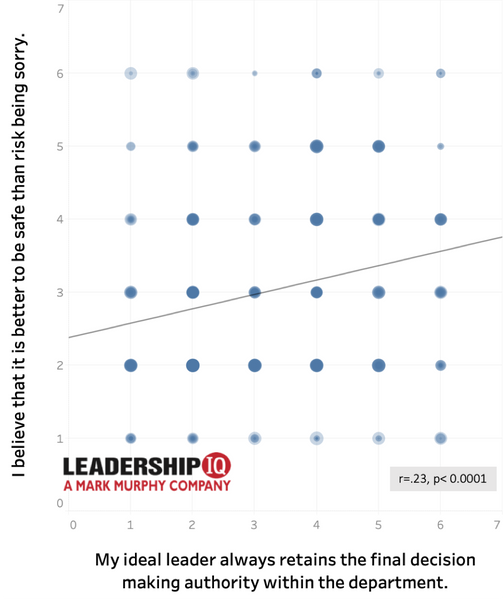
Bold, audacious risk-takers are not likely to enjoy a leader who always retains the final decision-making authority. But someone with a more cautious personality is less likely to see that as a problem—and may actually find it reassuring. The scatterplot confirms that risk aversion and autocratic leadership preference move in the same direction.
Personality Characteristic #5: Don't Break It
There is a strong strain of caution in autocratic leadership. Order and consistency are prized; chaos and ambiguity are not. We can see why someone who believes "if it ain't broke, don't break it" is more likely to respond positively to autocratic leadership.
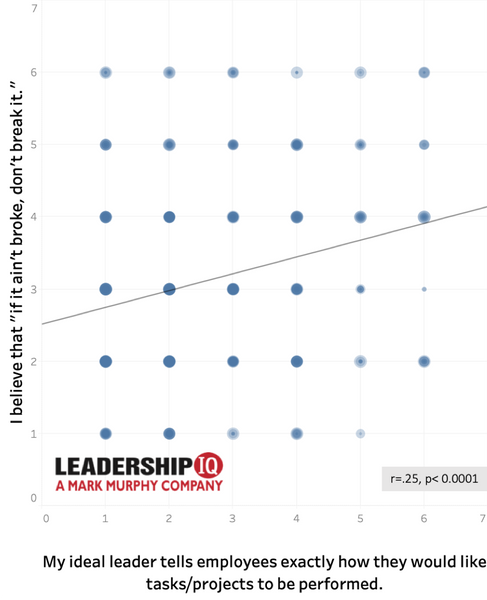
Those who look for "sacred cows" to tackle are unlikely to respond well to the autocrat. But for someone who likes to let "sleeping dogs lie," autocratic leadership could actually be desirable. This characteristic is especially relevant in stable industries where maintaining existing systems is more valuable than disrupting them.
Personality Characteristic #6: Be Satisfied With What You Have
Autocratic leadership maintains a clear hierarchy and order. And if you're not at the top of that hierarchy, you're probably going to be unhappy if your personality doesn't allow you to be comfortable not being at the top. When someone believes it's important not to ask for more than what you have and that people should be satisfied with what they have, they're much more likely to accept their place in the hierarchy (and thus accept autocratic leadership).
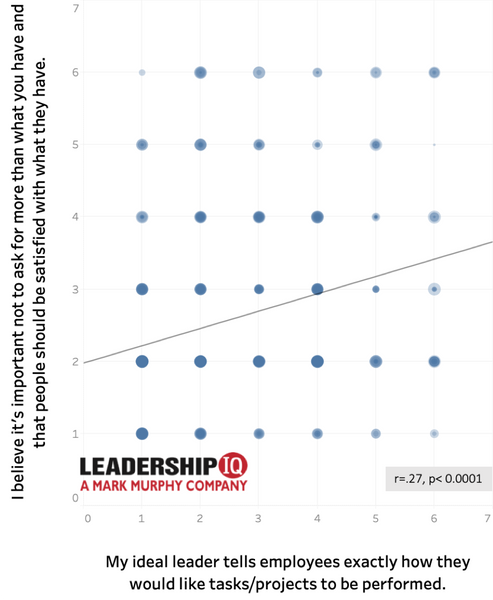
While ambition is an often laudable characteristic, autocratic leadership won't allow for that ambition to roam unbridled. The data shows that people who are comfortable within established structures—rather than constantly pushing against them—find autocratic leadership significantly more tolerable than those who don't.
Personality Characteristic #7: Make Decisions Carefully
Given the autocratic leader's emphasis on formal procedures, strict rules, and setting clear expectations, it's no surprise that their followers tend to favor making decisions by way of careful, detailed analysis.
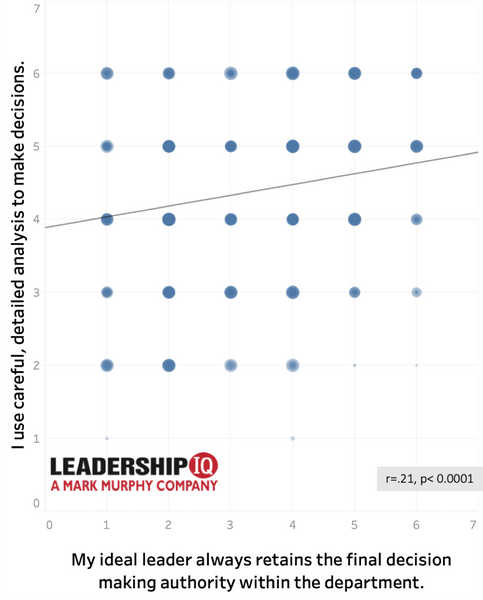
If someone uses careful, detailed analysis to make decisions, they're more likely to have a personality that fits well within an autocratic environment. The systematic, rule-based nature of autocratic leadership appeals to people who prefer structured thinking over intuitive leaps—and the data confirms this correlation clearly.
Autocratic Leaders: Real-World Profiles
Steve Jobs, co-founder of Apple, exemplified autocratic leadership by making unilateral decisions about product design and company direction, which significantly shaped Apple's brand and technological innovation. Jobs maintained strict control over every detail of Apple's products, from hardware design to packaging. His autocratic approach produced extraordinary results—but also created a work environment that many employees found exhausting and difficult.
Elon Musk is known for his hands-on, highly directive leadership style, making major business decisions independently and setting high expectations for employees, particularly during Tesla's production challenges with the Model 3. Musk's approach demonstrates both the benefits of autocratic leadership (rapid decision making, clear direction during crises) and its costs (high employee turnover, burnout, and public criticism of his management style).
Mary Barra, CEO of General Motors, demonstrated autocratic leadership by taking swift, unilateral action during a major safety crisis, implementing a comprehensive safety review and recalling over 30 million vehicles. In crisis management situations like these, the autocratic style's strength is undeniable—decisive action saved lives and protected the company.
These examples illustrate an important nuance: autocratic leaders can be highly successful, but the style works best when applied to situations that demand speed, clarity, and centralized control rather than as a default approach to every situation.
Autocratic Leader Versus Authoritarian Leaders
The terms "autocratic" and "authoritarian" are often used interchangeably, but there's a useful distinction. Autocratic leadership refers to a directive management style where one leader retains decision making power. Authoritarian leadership carries a stronger connotation of coercion—using power to suppress dissent rather than simply centralizing decisions for efficiency.
In practice, the overlap is significant. Both involve strict control, limited subordinate input, and hierarchical structures. The difference is one of degree and intent: an autocratic leader may centralize decisions because they believe it produces better outcomes; an authoritarian leader may centralize power to maintain control for its own sake. The interpersonal relationships between leaders and followers differ accordingly—autocratic leaders can still maintain respect if they're competent and fair, while authoritarian control tends to erode trust over time.
Benefits: When Autocratic Leadership Works and Crisis Management
The key benefits of autocratic leadership are speed, clarity, and accountability:
Rapid decision making: When only one person needs to evaluate and decide, decisions happen faster. In crisis management situations—a product recall, a security breach, an operational emergency—this speed can be the difference between containment and catastrophe.
Clear direction: In highly structured environments, autocratic leadership eliminates ambiguity. Everyone knows exactly what to do because the leader has defined it explicitly. This clarity reduces errors, especially with inexperienced teams who need guidance rather than autonomy.
Operational consistency: Autocratic leadership ensures that processes are followed uniformly. In military operations, manufacturing, and compliance-heavy industries, this consistency is essential for safety and quality.
Suitability for high-risk teams: When the consequences of mistakes are severe—patient safety in healthcare, structural integrity in construction, mission success in military operations—the tight control of autocratic leadership provides a necessary safety net.
Cons of Autocratic Leadership
The disadvantages of autocratic leadership are equally well-documented:
Lower morale and employee satisfaction: While autocratic leadership can provide structure, it often stifles employee creativity and results in lower employee morale compared to more participative styles. This leadership style can lead to low morale and productivity, making employees feel undervalued when their own ideas are never solicited or considered.
High turnover: High turnover rates can result from autocratic leadership due to lack of trust or micromanagement. When employees have little or no input into how they work, the most talented ones—who have options—tend to leave first. While autocratic leadership can provide structure and clear direction, it may not be suitable for environments that thrive on creativity and collaboration.
Stifled innovation: When group members aren't encouraged to contribute ideas or challenge the leader's thinking, employee creativity suffers. Innovation requires experimentation, risk, and the freedom to fail—none of which align with strict control.
Single-leader dependency: When absolute power resides in one person, the organization becomes fragile. If that leader is absent, incapacitated, or wrong, there's no distributed capability to compensate. The entire system depends on one individual's judgment.
Burnout risk: Autocratic leaders who absorb all decision-making responsibility can burn out from the volume of decisions they need to make. The leadership experience becomes unsustainable when every choice flows through a single point.
How Autocratic Leaders Can Improve: Coaching Leadership and Active Listening
The most effective autocratic leaders recognize that their style, while powerful in specific contexts, needs to be tempered with elements from other leadership approaches. Here's how:
Blend with coaching leadership: A coaching leadership style focuses on developing employees' capabilities through feedback and skill-building. Autocratic leaders who incorporate coaching behaviors—asking questions, providing developmental feedback, investing in their people's growth—retain their decisiveness while building a more capable and engaged team. Coaching leaders develop people; autocratic leaders direct people. The combination produces teams that can execute with precision and grow at the same time.
Actively listen to team input: Autocratic leaders don't need to turn every decision into a committee discussion. But creating structured channels for team members to share information, flag concerns, and contribute ideas—even when the leader retains final authority—prevents the isolation and blind spots that pure autocratic leadership creates. Leaders who actively listen make better decisions because they have access to information that wouldn't otherwise reach them.
Provide training and tools: Rather than directing every task, invest in building your team's capability so they can handle more responsibility over time. This doesn't mean abandoning the autocratic style—it means ensuring that when you direct, you're directing a team that's equipped to execute at a high level.
Recognize and reward team successes: Autocratic leaders often focus exclusively on compliance and error correction. Adding genuine recognition for strong performance—not just the absence of mistakes—improves employee engagement and encourages the behaviors you want to see more of.
Comparing Autocratic Leadership to Other Leadership Styles
In contrast to autocratic leadership, democratic leadership encourages collaboration and shared decision-making, allowing team members to contribute ideas and decisions, which fosters employee engagement and innovation. Visionary leaders focus on inspiring through a compelling future vision rather than directing through authority. Servant leaders prioritize the growth and well-being of their team members, which is essentially the inverse of the autocratic approach. Laissez-faire leadership grants autonomy that autocratic leadership explicitly withholds. Pacesetting leadership demands excellence by example but doesn't necessarily centralize all decisions the way autocratic leadership does.
Each of these many leadership styles has contexts where it excels. Among all the different leadership styles available, the right leadership style depends on the team's experience level, the urgency of the work, the organizational culture, and the specific outcomes the leader is optimizing for. Leadership theories consistently show that the most effective leaders are not locked into one approach—they select the style that fits the moment.
Practical Implementation Steps
If you're considering when and how to use autocratic leadership (or evaluating whether you're overusing it), here are concrete steps:
Audit your current decision processes: Map which decisions you're making unilaterally, which you're making with input, and which you're delegating. If everything flows through you, you may be more autocratic than the situation warrants.
Define roles within the clear chain of command: Autocratic leadership works best when the hierarchy is explicit and understood. Make sure everyone knows their role, their authority boundaries, and the escalation path. Ambiguity in a directive system creates confusion rather than efficiency.
Pilot autocratic decisions during high-stakes scenarios: Rather than applying the style universally, identify the situations that genuinely require rapid, centralized decision making—crisis management, compliance requirements, safety-critical operations—and use autocratic methods there. For everything else, consider whether democratic, coaching, or delegative approaches would produce better results.
This Is Not an Endorsement but a Call for Deeper Understanding
Because more than 500,000 leaders have taken the online test "What's Your Leadership Style?" we know that styles with autocratic leadership elements are preferred by a minority of leaders. And autocratic leadership is far less common today than it was when Kurt Lewin's seminal 1939 study "Patterns of aggressive behavior in experimentally created social climates" distinguished between Autocratic, Democratic, and Laissez-Faire leadership styles.
In Lewin's study, groups of 10-year-old children were placed successively under autocratic, democratic, and laissez-faire leadership. Overall, the researchers found that while autocratic leadership could deliver increased productivity, followers of the autocratic leader could be joyless, frustrated, and dependent. In one experiment, hostility was 30 times as frequent in the autocratic setting as under democratic leadership. In other experiments, participants under autocratic leadership showed extreme non-aggressive, apathetic behavior—a pattern that mirrors the employee engagement challenges organizations see today when the autocratic style is overused.
As shown in the Leadership IQ study, autocratic leadership is not a commonly desired or preferred leadership style. In Lewin's research, 19 out of 20 participants liked their democratic leader better than their autocratic leader, and 7 out of 10 also liked their laissez-faire leader better. And yet, some participants responded to the laissez-faire leader by saying "he was too easy-going"; "he had too few things for us to do"; "he let us figure things out too much." Even decades ago, the data showed that certain personality types want more structure, not less.
Autocratic leadership might not be the ideal leadership approach for a company that needs more innovation or better employee morale. Autocracy is likely to decrease, not increase, employee engagement. And autocratic leadership (or authoritarian leadership) is unlikely to improve collaboration, teamwork, and creativity.
But with the right mix of personalities—people who value rules, consistency, careful decision making, and a strong leader who provides clear direction—autocratic leadership can deliver results. Especially when employees aren't clear about what's expected, when people have great ideas but poor execution, or when the trains just are not running on time.
Understanding this leadership style based on data rather than ideology is what separates a successful leader who can deploy many leadership styles from one who's locked into a single approach. The leadership experience that produces the best outcomes isn't about finding the one right style—it's about having the leadership skills to match the style to the moment.
Take the leadership styles quiz to discover your preferred leadership style and explore Leadership IQ's training programs for development that builds range across the full spectrum of leadership approaches.